Open Dialogue
Open Diaologue, history and results
In the 1980s, in the northern Finnish province of Western Lapland, the occurrence of mental health problems was extremely high. A team of psychologists and psychiatrists, including Jaakko Seikkula at the University of Jyväskylä, was looking for better ways to support people experiencing a substantial psychological crisis. From this search, the Open Dialogue approach was developed and initially used as treatment for early psychosis. Later it became a well-defined system of care offered to anyone asking for mental health support in Western Lapland.
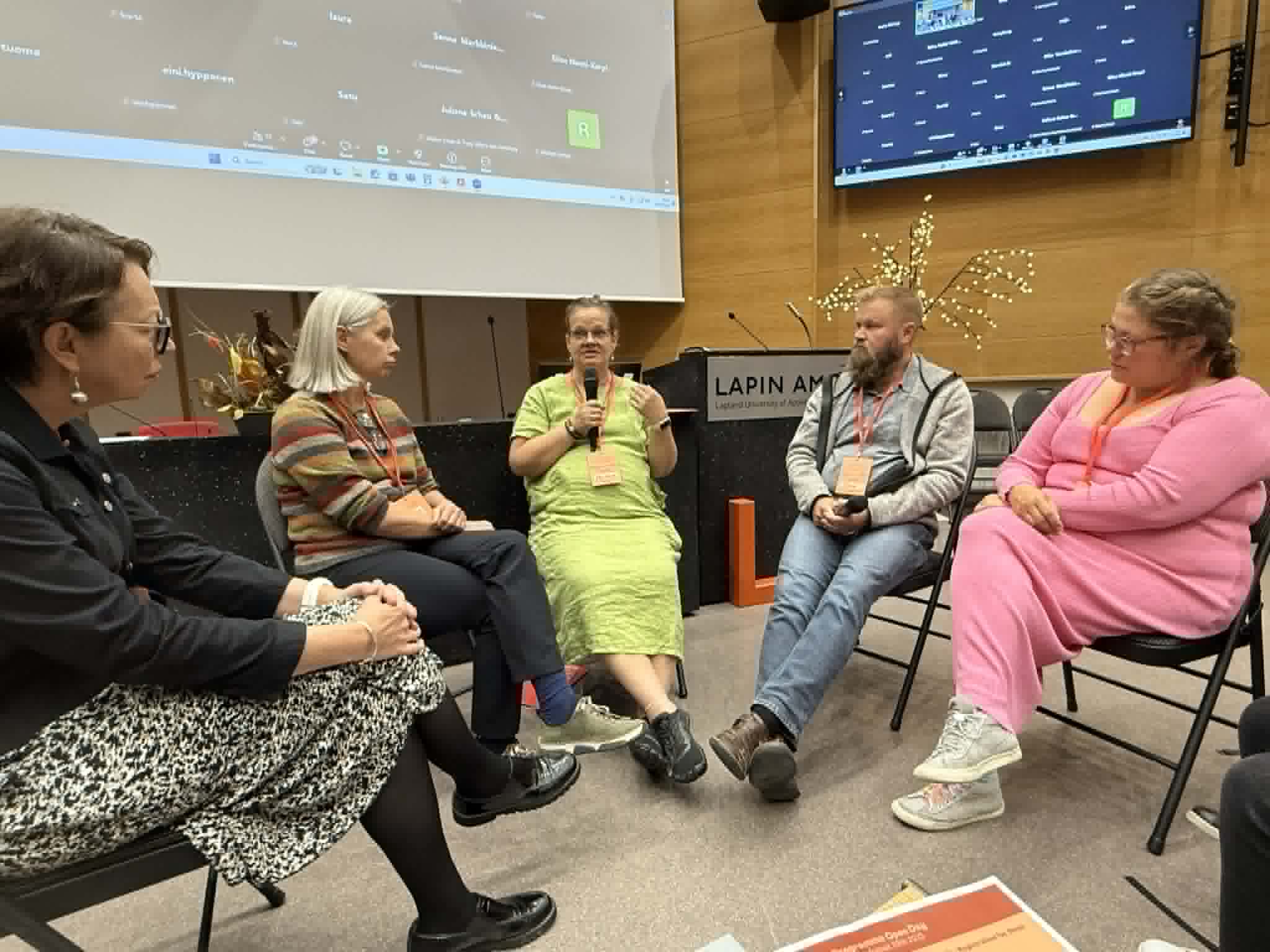
Open Dialogue involves meetings with at least two professionals, the “person at the center of concern”, his/her family- and social network to provide care within their personal support systems. Clinicians strive to assist clients and their families at home, making treatment decisions collaboratively, including decisions about medications.
Open Dialogue Principles
Over decades of research and practice, seven structural principles were identified to describe how Open Dialogue meetings are organised and carried out. More recently, twelve therapeutic principles have been developed to support the implementation of Open Dialogue internationally.
Open Dialogue can be described as a human rights-aligned approach, where a non-institutional and non-medicalizing approach minimizes the power imbalance between clinicians and clients.
The Seven Structural Principles
The seven structural principles provide the organisational framework for Open Dialogue. They describe how services are arranged and delivered, ensuring that support is timely, flexible, continuous and centred on the individual and their social network. Together, these principles create the conditions for dialogue, collaboration and shared responsibility throughout the recovery process.
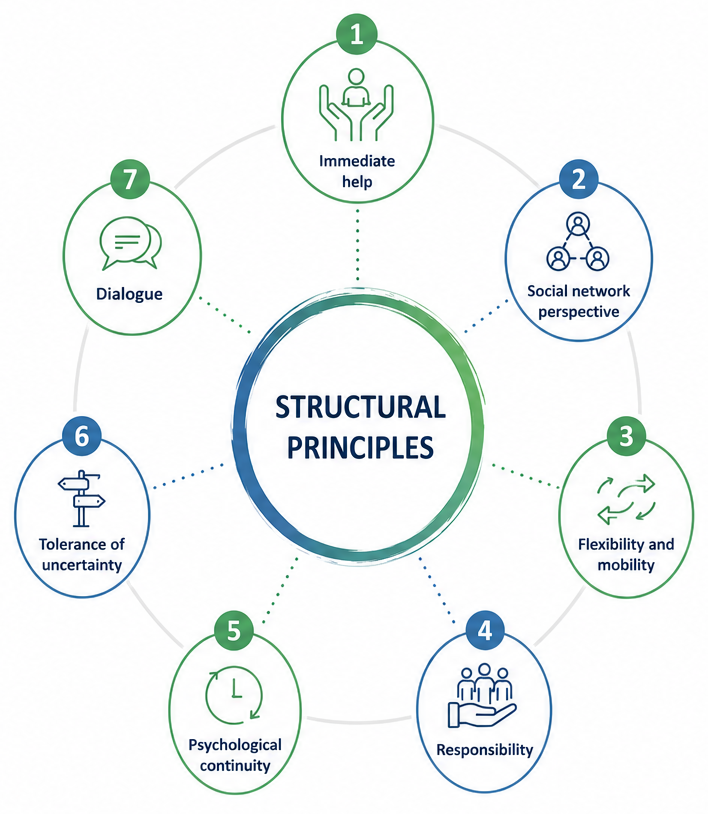
1. Immediate Help
Support is offered as quickly as possible after first contact. Early meetings help reduce distress and ensure that everyone important to the situation can be involved from the beginning.
2. Social Network Perspective
The person’s family, friends and other significant people are invited to participate whenever appropriate. The wider social network is seen as an important resource for understanding and responding to the situation.
3. Flexibility and Mobility
Support is adapted to the unique needs of each person and their network. Meetings can take place in different settings and evolve as circumstances change.
4. Responsibility
The professional or team first contacted takes responsibility for organising the initial response and ensuring continuity until appropriate support is in place.
5. Psychological Continuity
Whenever possible, the same team remains involved throughout the process. Consistent relationships help build trust and support recovery over time.
6. Tolerance of Uncertainty
Rather than rushing to conclusions or immediate solutions, the process creates space for uncertainty while dialogue unfolds. Safety is fostered through regular meetings and shared understanding.
7. Dialogue
Every participant’s voice is valued equally. Through genuine dialogue, new understanding and meaning can emerge collaboratively rather than being imposed by professionals.
The Twelve Therapeutical Principles
While the structural principles describe how Open Dialogue services are organised, the therapeutic principles describe how dialogue unfolds within meetings. They offer practical guidance for clinicians and peer practitioners, emphasising curiosity, transparency, responsiveness and the inclusion of multiple perspectives. Rather than relying on predetermined interventions, the therapeutic principles help create conversations where meaning can emerge collaboratively and recovery can be supported through genuine dialogue.
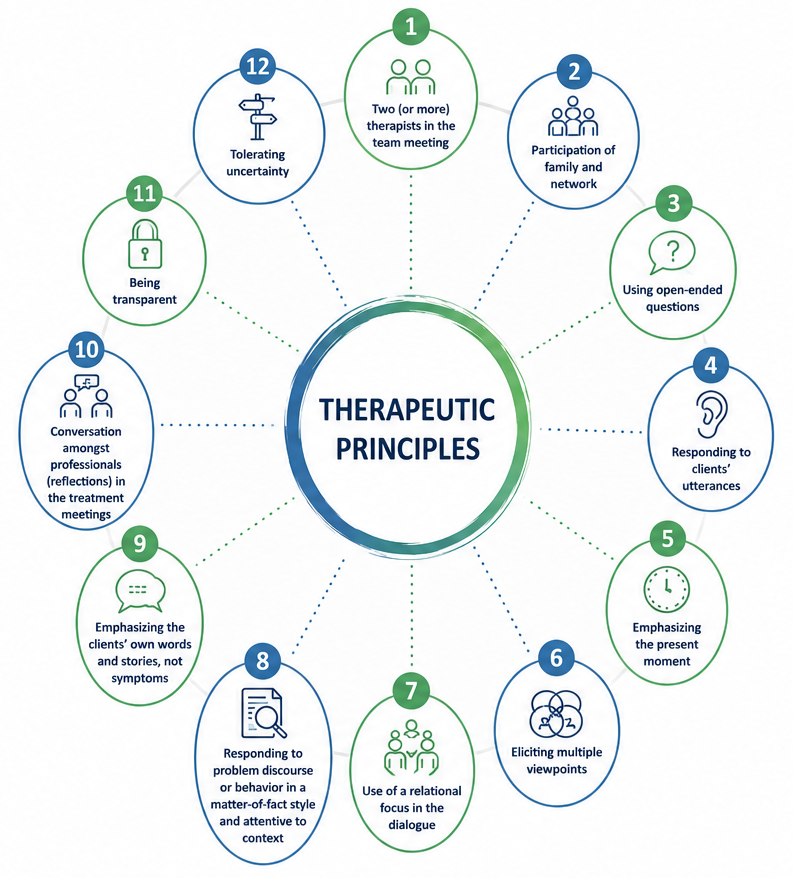
1. Two (or More) Therapists in the Team Meeting
Meetings are facilitated by at least two practitioners, creating opportunities for collaboration, reflection and shared responsibility.
2. Participation of Family and Network
The person’s family members and wider social network are invited to participate whenever appropriate, ensuring that multiple perspectives are included.
3. Using Open-Ended Questions
Open-ended questions encourage reflection and dialogue rather than seeking predetermined answers.
4. Responding to Clients' Utterances
Professionals respond to what is actually being expressed in the moment, allowing each contribution to shape the conversation.
5. Emphasising the Present Moment
Attention is given to what is happening in the meeting here and now, recognising that important meaning emerges in the present interaction.
6. Eliciting Multiple Viewpoints
Different experiences and perspectives are welcomed without seeking a single “correct” interpretation.
7. Using a Relational Focus in the Dialogue
The conversation explores relationships between people and the meanings that arise between them, rather than focusing solely on individuals.
8. Responding in a Matter-of-Fact Style and Attentive to Meanings
Professionals respond respectfully and naturally while remaining attentive to the personal meaning behind what is being shared.
9. Emphasising the Clients' Own Words and Stories, Not Symptoms
Priority is given to the person’s own language and lived experience rather than interpreting experiences primarily through diagnostic labels.
10. Conversation Among Professionals in the Treatment Meetings
When professionals reflect together, they do so openly within the meeting, allowing everyone to hear and respond to their thinking.
11. Being Transparent
Thoughts, decisions and uncertainties are shared openly with everyone present, supporting trust and collaboration.
12. Tolerating Uncertainty
Professionals resist the pressure to provide immediate explanations or solutions, allowing understanding to develop through ongoing dialogue.
Good Outcomes in Finland
Outcome studies showed that two years after the onset of psychosis, 84% of the patients had returned to full-time jobs or school, and only 33% had used neuroleptic medications. In usual care, almost everyone diagnosed with psychosis receives neuroleptic medication at the outset, and only a minority of them is symptom-free after 5 years.
Other treatments for psychosis give good immediate outcomes as well, but over time, their effectiveness decreases or is not clear. A recent long-term study showed that many positive outcomes of Open Dialogue are stable after 19 years, including a reduced need and duration of hospital treatment, disability allowances, and neuroleptics.
Spread around the word!